

The Audience
A circus parable

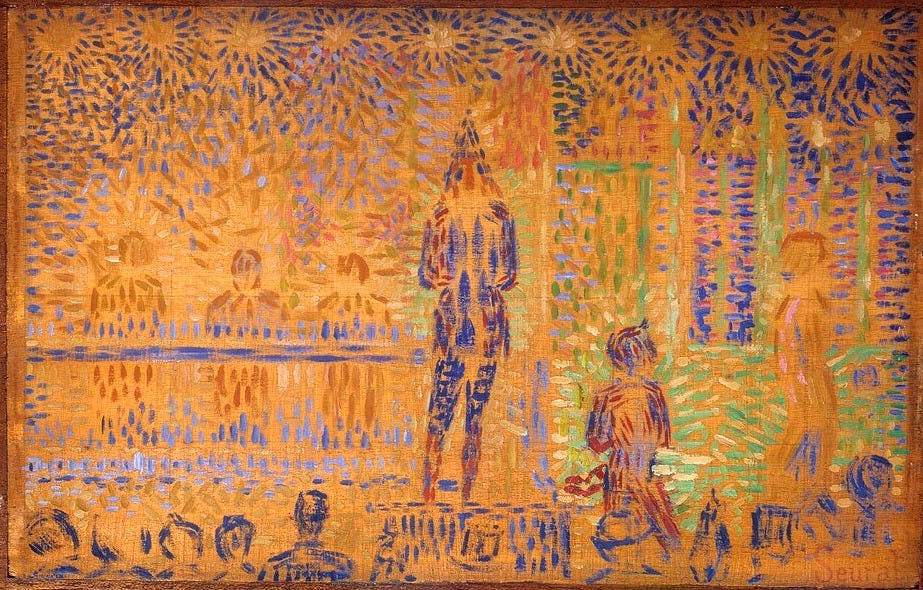
There once was a great circus performer who, in his day, had been an unrivaled master of the seven circus arts. He had performed death-defying feats and delighted audiences everywhere he went.
The performer had a son, his only son, whom he loved. The boy was a dreamy, gentle child, who loved to wander alone in the fields and forests beyond the circus grounds, speaking and singing to himself. From the time the boy was small the father had taught him the arts of the circus – how to balance, soar, and tumble, how to make the audience laugh and applaud. “You must always please the audience,” he would say. But for protection for the boy, the father had never allowed him to come into the circus tent. There were dangers and mysteries there of which he could not speak.
Now the father was aged – his beard was long, his eyesight was fading, and he could no longer grip the trapeze. And the boy was now a young man.
So the father called for his son and spoke: “Throughout my years performing in the arena,” he said, “the roar of the audience has been my companion. I have heard their laughter and their applause. But the lights in the arena are bright, my son. And as a performer, they are always in your eyes. Because of this, in all my years, much as I have strained to look and much as I have yearned for just one glimpse, I have only heard the audience. I have never seen them.
“Now it is time,” he continued, “for you to take my place in the great tent. I have taught you everything I know, and you are well-prepared. But to meet the soul’s longing, there is one thing that I will require of you in return; one task before you may come home: You must bring me a picture of the audience.”
The young man loved and trusted his father, but he feared the circus. He did not want to balance on a wire high in the air or dress like a clown and play the fool for his livelihood. He feared the heights, he feared the fire, he feared the lions. Most of all he feared the audience. How could he ever capture their picture if his father could not?
So the young man delayed. He said to his father, “I have all the skills you’ve taught me, but where are the circus regalia? Where are the stilts I will use? Where is the pole for me to balance on the wire? Where is the clown costume I will wear?” His father replied, “The Circus Master will provide the regalia, my son.”
His father took him by the arm and brought him to the great circus tent. It appeared to the young man like a dark, towering cumulonimbus cloud, full of mystery and terror. The dark tent flap waved, ushering him in. He resisted, but his father pushed him through the doorway, and he stepped across into the thick darkness.
As soon as he entered the tent, the darkness convulsed and flashed like a gleaming cockroach and brilliant light flooded his eyes. It was so bright, beaming from every direction, that the young man could see nothing at all. He closed his eyes and saw the glow of the stage lights through his lids.
He could hear a cacophony of sounds all around, unlike any he had ever heard – otherworldly murmurs and echoes, snippets of conversation, his mother’s lullaby, the far distant roar of lions, beasts screeching and howling. Static, tinnitus. The sounds rose and fell together, undulating like a single symphony. The young man covered his ears and heard uproarious laughter.
“You’re late,” said a woman’s voice sharply next to him. “You’re keeping the audience waiting. Open your eyes and take your hands out of your ears. You look like a fool.” The young man squinted his eyes open and saw the glowing outline of a giant clown standing before him, perhaps nine feet tall – white face, huge red nose, permanent painted smile, polka dotted shirt, long hair down to her knees. He remembered now – his father had told him about this female giant. This was the Circus Master.
The Circus Master produced a tall mirror, seemingly from thin air, and showed the young man his reflection. The young man was astounded to see that he too was dressed in a clown suit, his own face plastered white with a permanent red smile. He barely could recognize himself.
“I assume,” said the Circus Master, “that you’ve been properly instructed as to the means of your survival: You must perform to the satisfaction of the audience. You will need to delight them with your cheerfulness and thrill them with the precarity of your stunts. You must always wear a costume. The audience at this august circus has high standards and nothing is guaranteed.”
The young man looked around. The stage was vast, encircled by blinding lights. He could not see even a hair or a shirtsleeve of the audience, but he could feel their eyes on him and hear their impatient murmuring as they waited for him to begin.
He noticed for the first time other performers on the stage, dozens of translucent, sepia beings. The stage lights seemed to shine straight through their bodies as if they were naked souls. Each was repeating his own act like a record skipping and returning – one on a trampoline flipping over and over; one riding a unicycle in a small circle, round and round; one swallowing a sword again and again. Fear grew in the young man’s stomach. Was he doomed to be imprisoned here, repeating his act forever? He felt frozen in place, unable to speak.
The Circus Master spoke with tenderness, “I know you’re afraid. But you must begin your performance now. To ease your way, I offer you a gift: this vial of wire and voices. It is a stimulant for success and a quasher of qualms. When you place this vial on your body, you will become proficient in the act you are performing at that moment. And the audience will love you.” The young man took the vial of wire and voices from the Circus Master and placed it in his pocket.
“The first act,” announced the Circus Master in a booming voice, “is the buffoonery of the clown.” The young man quailed. He remembered what his father had taught him, but how could he do it? He was a quiet, shy, studious man. He didn’t belong here. But he took the vial out of his pocket and placed it against his chest.
Instantly he felt a surge of vibrating energy, like helium filling the balloon of his body, and with his heart racing, he found himself prancing across the stage as if propelled by a hidden engine, dancing like a fool, pantomiming silly stories, pulling balloons from his vest, and slipping on banana peels. He heard the audience laughing, then cheering. They loved him! It was intoxicating – a rush of exhilaration. The act came to a close, the vibration drained from his body, and he was left standing, weary, in the middle of the stage.
Under the shadowless glare of the stage lights, in the maddening cacophony of murmurs and admonitions, each act arose in turn, announced by the Circus Master. Each taught the young man a bitter lesson. The second act was stilt walking (you must be taller, bigger, better). The third was juggling (to do one thing at a time is never enough.) The fourth was acrobatics (you must not stay rooted in one place). The fifth was the high wire (stay reasonable and balanced in the middle, please everyone on all sides). The sixth was the trapeze (jump and grab each opportunity as it comes to you – if you miss it, you’ll die).
Each time, something deep within him rebelled. Something quietly wailed. But each time, he would reach into his pocket, withdraw the vial of wire and voices, and press it to his chest. The vibration would begin, his body would lock into the movements he had learned, and the audience would applaud. Hearing their applause, the young man would be pacified.
In between acts, in the brief moments with the vial in his pocket, he would wonder – Why was he here? Why had he not run away from this pharaonic place? He would yearn for the freedom of the fields of his youth. He remembered how he would spend entire afternoons dreaming, his feet in a stream, staring at the sky, listening to the song of the grasses.
The Circus Master startled him out of his revery: “At last, ladies and gentlemen, it is time for our performer’s final act – the moment you’ve all been waiting for…” Through an invisible opening, a great lion appeared in the arena, roaring and pacing back and forth. The sepia beings shrank back in fear. The audience gasped. Someone screamed. The Circus Master continued: “Before our eyes, our brave performer will make this lion jump through a hoop of fire! Once and for all, he will tame the king of the jungle!”
The young man stood facing the lion, trembling. He felt the audience lean forward; breath held in anticipation. He saw the hoop of fire on a stand in the middle of the stage. He found that he was holding the handle of a long whip. He felt the vial heavy in his pocket.
The lion’s eyes flashed and locked with the young man’s. His great mane was a glowing corona, continually unfolding, rippling, and flowing outward. He roared with a hundred voices. He moved slowly, with grace and coiled power, radiating profound goodness. The young man had never seen anything more beautiful in his entire life. He had never loved anything more.
Like a flash flood, something surged within the young man – an exquisite rage and a wild, reckless recognition: nothing on earth, not even pain of death, could compel him to harm this creature. He did not care what the Circus Master wanted. He did not care what the audience wanted.
The moment this knowledge arose in his consciousness, the arena went silent. The cacophony was gone. For the first time since he had entered the circus tent, the young man could hear wind blowing outside. And for the first time, he had clarity. Under the bright lights, in the preternatural stillness, he withdrew the vial from his pocket. He hurled it with all his might, as high and far as he could, into the audience.
As the vial soared and disappeared into the bright silence, the ground began to shake. The bulbs of the stage lights began to flicker and fade. The flaming hoop toppled over, and the flame went out. The tent columns began to crack, and the fabric overhead began to tear. Long strips of cloth fell onto the stage like a silky rain. He heard a sound like thunder. As the sky opened above, a new, cool light, like moonlight, was gently filling the arena. And with a puff of smoke, the last of the stage lights went out.
As his eyes adjusted to the new light, the young man looked at the stage with wonder. He could still see the lion, sitting down now, and the sepia beings were waiting there. Stilts, poles, unicycles, and circus regalia were scattered around. All that had agonized him now looked so ordinary, so simple and benign.
At last, he turned toward the audience stands, preparing to feast his eyes on what he had most craved and feared. Nothing in his lifetime could have readied him for what he now saw: The stands were empty – no children, no adults, no buckets of popcorn, no sign of anyone ever having been there. He heard the Circus Master laugh. There was no audience.
Astonished, he touched his forehead and white face paint came off onto his fingers. Feeling rising joy, the next step became immediately apparent: He picked up a piece of fallen debris, a bright red circus poster. Working quickly, he sketched the empty stands, white chalky paint from his face on the back of the red poster. When he was satisfied, he rolled it up.
The young man carried his drawing with him as he walked out down the aisle, between the stands, with the ruins of the circus like a wall to his right and to his left. The lion went with him, followed by all the sepia beings, and the Circus Master last. They stepped out into the fragrant, cool night air. They could hear the song of the grasses as they danced into the open field.
Simply magnificent writing.
Thanks, Judy. Glad you enjoyed it.